
Brook trout are the only members of the trout family that are native to Georgia. Prior to the Europeans, the brook trout were found in certain mountain streams of far north Georgia, North Carolina, South Carolina, Tennessee and were scattered across all the Appalachians all the way to Maine. In the southern range the fish were restricted to the higher elevations where the waters stayed cold enough for the fish to prosper. Prior to the arrival of the Europeans the brook trout were plentiful and existed in many of the larger cold water streams. When the timber industry indiscriminately cut the mountain forests and left the hillsides barren, the sediment and lack of shade pushed the Brookies to near extinction.
All trout species are found in streams that are cold and oxygen rich. In the United States these cold water streams are found in the mountains, and upper elevations or in the northern latitudes with the exception being artificially cold tailrace waters. In the Southeast, especially Georgia, there are not enough native brook trout in the streams to satisfy the angler pressure that currently exists. If not for non-native trout we could have already pushed the native brook trout to extinction.
In 1883, under the authorization of the U.S Fish Commission, Fred Mather, a fisheries biologist made a trade with German fish culturist Baron Lucius von Behr. Mather sent Whitefish eggs to Germany, and von Behr shipped 80,000 brown trout eggs to America. The eggs were divided between two hatcheries in New York and one in Michigan and in 1884, America’s first Brown trout stocking was by the Northville Hatchery and took place in Michigan in the Baldwin River, a tributary of the Pere Marquette.
The first rainbow trout hatchery was on San Leandro Creek, near San Francisco Bay. The hatchery was stocked with the locally native rainbow trout, and likely steelhead. The fish raised in this hatchery were shipped by train to hatcheries out of state for the first time in 1875, to Caledonia, New York, and then in 1876 to Northville, Michigan.
Erwin National Fish Hatchery in Erwin Tennessee was established in 1894 to restore trout populations in Tennessee, North Carolina, and Virginia. In 1897 a total of 2,989 brook trout were collected from local streams to serve as broodstock. There was high mortality due to predation of the broodstock by feral cats and no eggs were obtained. By 1900 Erwin successfully raised trout and stocked about 40,000 rainbow trout and 30,000 brook trout that year.
Trout eggs were transported from the hatcheries in specially designed rail cars to other hatcheries across the country from as far away as California and Idaho. Newly reared trout from the local hatcheries were transported in similar rail cars to be stocked into streams that were once home to brook trout. In these early days of trout hatcheries in the United States the fish were either a few generations away from wild fish and sometimes the parent fish were wild and stream raised trout collected from local streams and rivers.
Early hatchery fish, mostly brown and rainbows were stocked into nearly barren brook trout streams, these nearly wild trout established reproducing populations of rainbow and brown trout and were able to survive warmer waters than the brooks. Stream born browns and rainbows are called “wild trout” and are found in many Southeast streams that have not been stocked for many years.
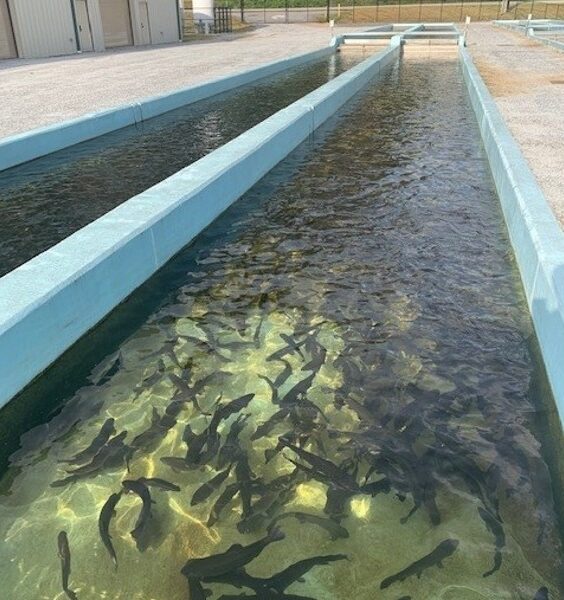
Now there is a huge demand for catchable size trout. Most of the trout in the modern hatcheries are far removed from the wild trout of their ancestors. Hatchery workers usually choose the fastest growing, most aggressive feeders to be the source of the eggs that will be raised in the hatcheries. These “brooder” fish are the result of many years of breeding the biggest, hungriest disease resistant fish. These fast growing trout can go from egg to catchable size in 12 to 16 months.
Todays stocked fish are so aggressive that they are usually caught within days of being stocked. If these hatchery fish are not caught only a few will live a second year. There isn’t enough food in many systems to satisfy their appetite, some die from predation and some from high temperatures.
Almost all states with trout streams have a trout stocking programs and Georgia has a very good one. Georgia stocks about one million trout each year and the majority of these fish are stocked into streams that have good public access. Remember that wild rainbow and brown trout are the result of stockings that took place years ago and these trout will help maintain the wild populations if returned to the stream unharmed. The likelihood of newly stocked fish reproducing is very small.